Hanging a garden gate on a slope sounds simple until the ground isn’t flat. Across Berkshire, Surrey and Oxfordshire, a sloping garden is more common than a flat one. Whether it’s a village plot up in the Chilterns, a garden on the North Downs, or simply ground that falls away from the house, the boundary rarely runs level. And a gate hung wrong on a slope announces itself daily: it swings open on its own, scrapes the path, or won’t close without a shove.
Here’s the single principle that fixes 90% of it: the gate hangs level and plumb, no matter what the ground is doing. The slope is the ground’s problem, not the gate’s. Once you accept that, everything else is just clearance.
Read the slope first
On a closeboard run, the fence itself either steps down the slope (panels stay level, dropping in stages) or rakes (follows the gradient at an angle). The gate is different from both, it always sits in a level, plumb opening. So before you touch a post, work out where the gate sits in relation to the fall of the land, because that decides which way it should swing.
Set the posts plumb, and treat them as load-bearing
This is where DIY gates fail. Gate posts take more strain than line posts, every open-and-slam is a lever working the post loose. So:
- Set both posts dead plumb (vertical), even though the ground slopes. A post that leans with the slope will make the gate swing on its own.
- Concrete them in properly and let them cure fully overnight before hanging. Hang it too soon and the weight pulls the post out of plumb before the footing has hardened, and the gate ends up sagging.
- The hanging post (hinge side) carries the load; set it deepest and in the most concrete. The slamming post (latch side) just needs to be solid and square to it.
Clearance: set it to the swing, not the ground
On flat ground you’d leave a consistent gap under the gate. On a slope you can’t, the ground rises and falls across the gate’s arc. So you set the gap to the highest point the bottom of the gate reaches as it swings, and let it clear from there.
The practical decision is swing direction. On a slope, swinging the gate toward the downhill side is the easy default, the ground drops away as it opens, so it clears naturally and you keep a neat, consistent gap underneath.
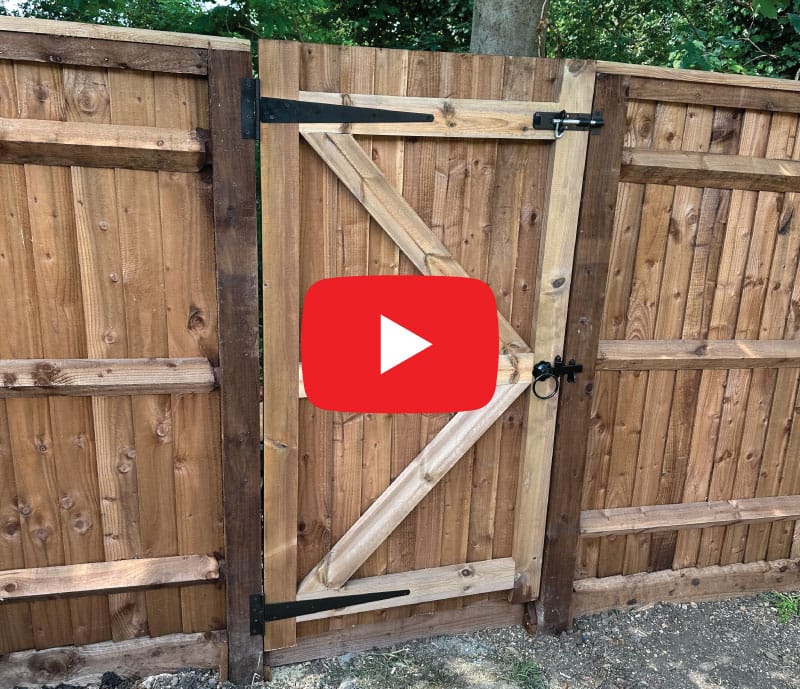
That said, swing direction is ultimately the customer’s call: where they want the gate to open, which way’s safest, what the path does. If they want it to swing uphill into the garden, you can absolutely do it, you just build in more clearance, setting the gap to the highest point the gate reaches through its arc and carrying a slightly larger gap at the closed end. The gate in the video below was hung to swing uphill at the customer’s request, a good example of making the harder direction work cleanly.
Hinges and bracing
- Use proper gate hinges fitted the normal way, 450mm band-and-gudgeon (strap) hinges are the standard for a domestic closeboard gate. Fit them as you would on the flat; the slope doesn’t change the hinges.
- Get the brace the right way round: the diagonal runs from the bottom of the hinge side up to the top of the latch side, which puts it in compression and stops the gate dropping.
When to call someone in
A level gate on a flat run is a fair DIY job. A heavy gate on a steep slope, where the posts are carrying real load and the clearance has to be exact, is where it’s worth getting a fencer in, a badly hung gate works the posts loose and eventually takes the adjacent closeboard with it.
If you’re in Berkshire, Surrey or Oxfordshire and you’d rather it was done once and done right, we cover the whole area and handle everything from a single gate to a full closeboard boundary.